


Great, American megacorporations care more about your privacy than the Canadian government.
 reclaimthenet.org
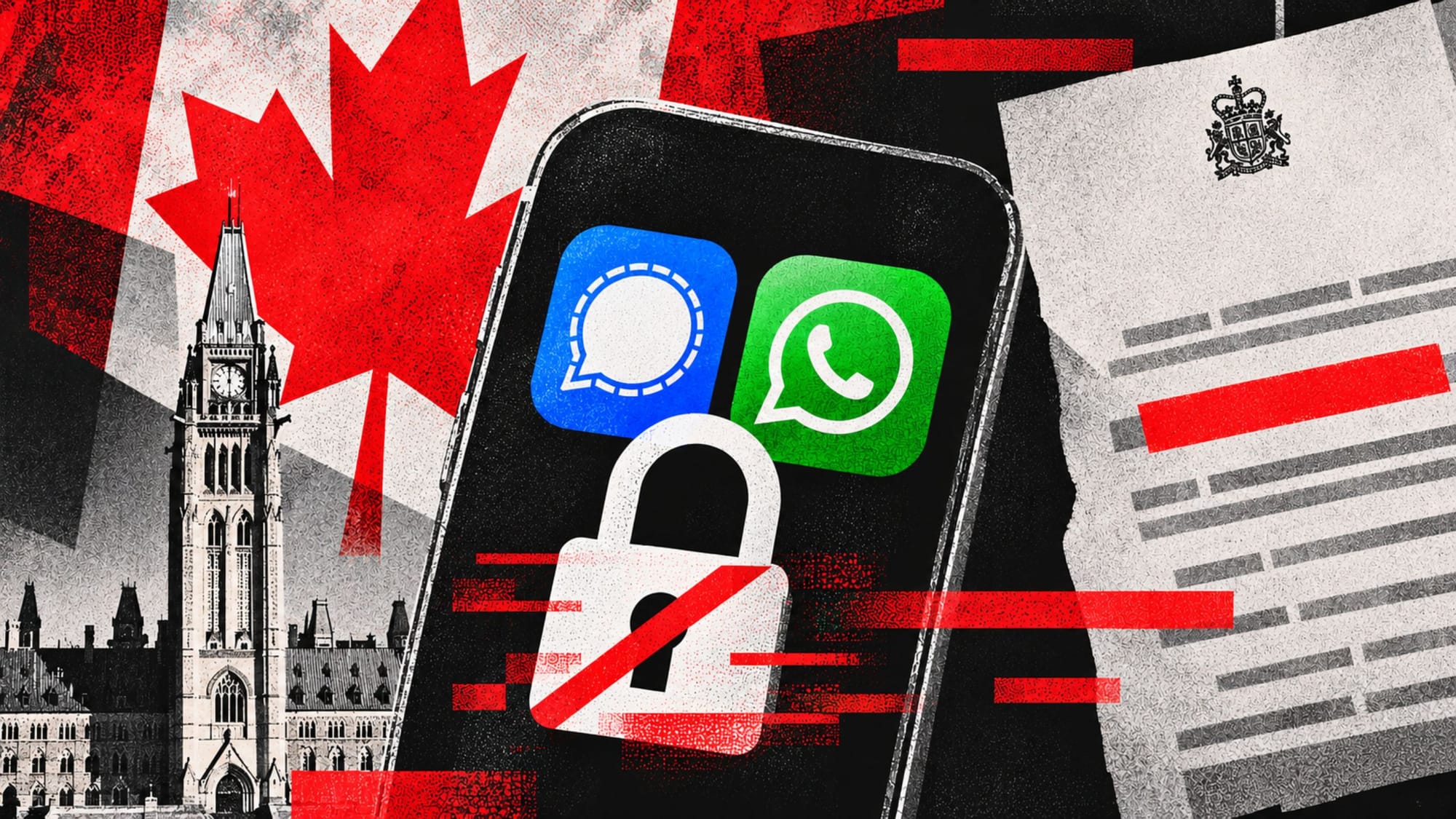
Signal Warns Canada It Will Leave Rather Than Weaken Encryption
A six month metadata rule and a secret order could turn every Canadian into a data point.
reclaimthenet.org
If you're tired of censorship and surveillance, subscribe to Reclaim The Net.
"If we are forced to choose between betraying our users and leaving Canada, we will not compromise the security of Canadians" – that's what Signal has told Canada's Senate national security committee.
The comment was made on Monday by Signal vice-president Udbhav Tiwari as the bill known as C-22, the lawful access bill, is being reviewed by the Senate, Canada's upper house, which can still propose amendments.
Meta, that also spoke at the committee, was less direct, but did not rule out pulling its services out of Canada if the law is passed. When asked directly if the company would consider doing that, Meta's head of public policy for Canada Rachel Curran said the company would have to review all of its options and consider it.
It's unclear what options Curran was referring to, but on Friday, in an interview with the National Post, she was more specific: "We're not going to break or weaken encryption, specifically vis-a-vis services like WhatsApp" - and if the company were served with an order to do that, it would have to consider its options.
To The Globe and Mail, Curran said, "We're not going to weaken or break our systems. That's a red line for us."
C-22 is the government's latest attempt to bring in new surveillance powers.
The Senate is the last legislative hurdle for the bill, and tech companies are making a last push to try to get it changed.
The bill has two parts, and the one that has to do with surveillance, the Supporting Authorized Access to Information Act, is of particular concern to privacy advocates and tech companies.
This part of the bill would allow the government to make providers build and maintain "operational and technical capabilities" for police and CSIS; install and maintain "any device, equipment or other thing" that "may enable an authorized person to access information" - and keep "categories of metadata" for periods "not exceeding six months."
The original bill had a one-year retention period, which was amended to six months – but the rule still applies to every single user, regardless of whether they are suspected of any wrongdoing.
The public safety minister would be able to make any of these demands in a secret order that would be valid for up to two years and approved by the Intelligence Commissioner. And the provider would be gagged: "must not disclose" what is in the order or "the fact that the electronic service provider is or was subject to the order."
That means that users would never know that their app had been "conscripted" in this way.
The six-month retention period was a concession, but Meta's Curran said this still "treats all Canadians as potential criminals" and that "Those databases…will inevitably become a target for bad actors as well."
The bill has provisions that are meant to act as safeguards. One is that providers do not have to comply with an order if doing so would introduce a "systemic vulnerability" - i.e., a backdoor. Another is that they do not have to decrypt data unless they themselves supplied the encryption and hold "the information necessary to decrypt the information."
However, there is a huge loophole: the definition of a systemic vulnerability does not include those that "relates only to information related to persons with respect to whom a warrant, order or other authority to access information" applies.
In other words, a vulnerability is not considered "systemic" if it is built for a specific target. And since the point of encryption is to treat all users the same, this exception effectively nullifies the rule, say critics.
The government's own page presenting the bill admits that the definition of systemic vulnerability was "amended to scope out those who are subject to a legal authorization to access their information" - while at the same time, that page claims, "Nothing in Bill C-22 would authorize surveillance of any kind."
Curran called this a "loophole": "So you build a backdoor for one targeted investigation, you basically compromise the entire system for everyone."
To the senators, she said the amendments to the original bill "have protected just the core and not the outside layers that are an integral part of the encryption process."
Another Meta representative, Robyn Greene, told the committee that the bill would force the company to act in a way that is not technically feasible: "Ultimately, the Canadian government would be enforcing and imposing a law that it is not technically feasible to comply with and still offer secure, end-to-end encrypted services to Canadians."
Meta is not alone in this assessment: in May, Google told MPs that the bill gave the minister "sweeping powers to issue secret orders" - while VPN providers Windscribe and NordVPN said they would either leave the Canadian market or limit their presence there in order to not have to log users, as the bill would require.
Reclaim The Net has been following this development for months. In October, Signal said it would not comply with orders that "can be ruinous for encryption and privacy for all Canadians." In November, the minister in charge of the bill said it was "deliberately broad," and an official explained that this could include "gaming platforms" with chat functions. Meta then said the bill's secrecy rules "disproportionately gag providers and undermine user trust."
The government's response has been to deny accusations that the bill would allow for indiscriminate surveillance and force companies to install backdoors into their systems. The spokesman for the public safety minister, Simon Lafortune, said that any claims suggesting otherwise were "incorrect" - even though the bill itself seems to say otherwise.
Outside the committee room, Apple, Alphabet, and Meta are lobbying hard in Ottawa to have the bill changed before it passes. Apple said earlier this month that the bill "could still undermine Apple's ability to offer the powerful privacy and security features our users expect from us, including encryption."
Curran agrees: "It probably puts Canada in a position where there's going to eventually be a bit of a standoff between service providers and the government, and it's not good for Canadians."
Meanwhile, the government seems to think that the bill is fine as it is. Earlier this month, the public safety minister, Gary Anandasangaree, said he did not expect the Senate to propose amendments to the bill.
The Senate is the last place to stop it.
Upvote
3