


Up to Half of Ontario’s Cigarettes Are Now Contraband, EY Finds, Pointing to Factories on Indigenous Lands That External Expert Sources Link to Cartels
OTTAWA — Two days before the Carney government tables a budget expected to carry a $63.3 billion deficit, a new study by the accounting firm EY Canada has estimated the nation is bleeding billions in tobacco tax revenue to black market factories sitting on Indigenous lands in Ontario and Quebec.
 open.substack.com
The results of rules and taxes for some.a new study by the accounting firm EY Canada has estimated the nation is bleeding billions in tobacco tax revenue to black market factories sitting on Indigenous lands in Ontario and Quebec.
The study cites a particular Ontario Provincial Police (OPP) investigation that The Bureau’s sources have connected to transnational narcotics networks that bring together Mexican cartels and Canada-based hybrid mafias believed to be central to the country’s fentanyl production and international trafficking.
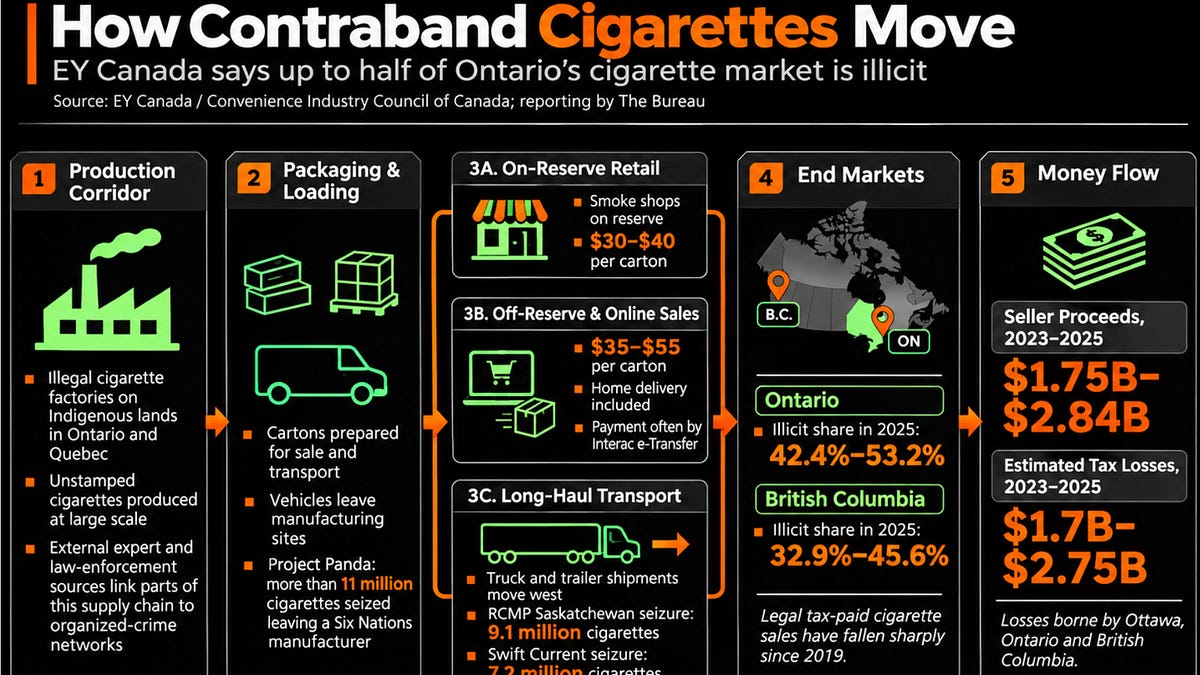
Up to one in two cigarettes sold in Ontario last year was contraband, the study found, and nearly one in two in British Columbia. Between 2023 and 2025, EY estimated, illegal sales cost Ottawa and the two provinces between $1.7 billion and $2.75 billion in tobacco tax and excise duty. Over the same period, the people selling those cigarettes took in between $1.75 billion and $2.84 billion.
The report was released Monday by the Convenience Industry Council of Canada. It is the fourth EY has prepared for the council, and it puts Ontario’s illicit share at between 42.4 and 53.2 percent of the market in 2025. British Columbia’s illegal market grew every year, from between 21.1 and 36 percent in 2023 to between 32.9 and 45.6 percent in 2025. Legal, tax-paid cigarette sales have fallen 46.4 percent in Ontario and 58.7 percent in British Columbia since 2019.
Ontario lost an estimated $690 million to $1.08 billion in provincial tobacco tax over the three years, according to the report. Ottawa lost a further $671 million to $1.05 billion in excise duty on cigarettes in Ontario alone.
British Columbia’s provincial losses ran as high as $400 million. The council noted that the findings land as Ontario projects a $16.9 billion deficit.
EY said the role of organized crime is “beyond the scope of this report.”
Upvote
5