ovarieasy
Based Member

Israel is 'the greatest decolonization project,' Indigenous leaders tell Toronto summit
The first-of-its kind Building Indigenous‑Jewish Friendship conference was the culmination of a weekend of Indigenous-Jewish programming
 nationalpost.com
The first-of-its kind Building Indigenous‑Jewish Friendship conference was the culmination of a weekend of Indigenous-Jewish programming
Israel is 'the greatest decolonization project,' Indigenous leaders tell Toronto summit
The first-of-its kind Building IndigenousâJewish Friendship conference was the culmination of a weekend of Indigenous-Jewish programming.
nationalpost.com
The state of Israel is “the most successful land‑back project, the greatest decolonization project,” a New Zealand Māori activist told the first-of-its-kind Building Indigenous‑Jewish Friendship conference in Toronto.
“From my Māori perspective, a key point is that there was always a continuous Jewish presence in the land; they kept the fires burning, and that is what indigeneity looks like to us,” Dr. Sheree Trotter told roughly 70 activists, academics and community figures convened at Toronto’s Beth Torah synagogue on Monday.
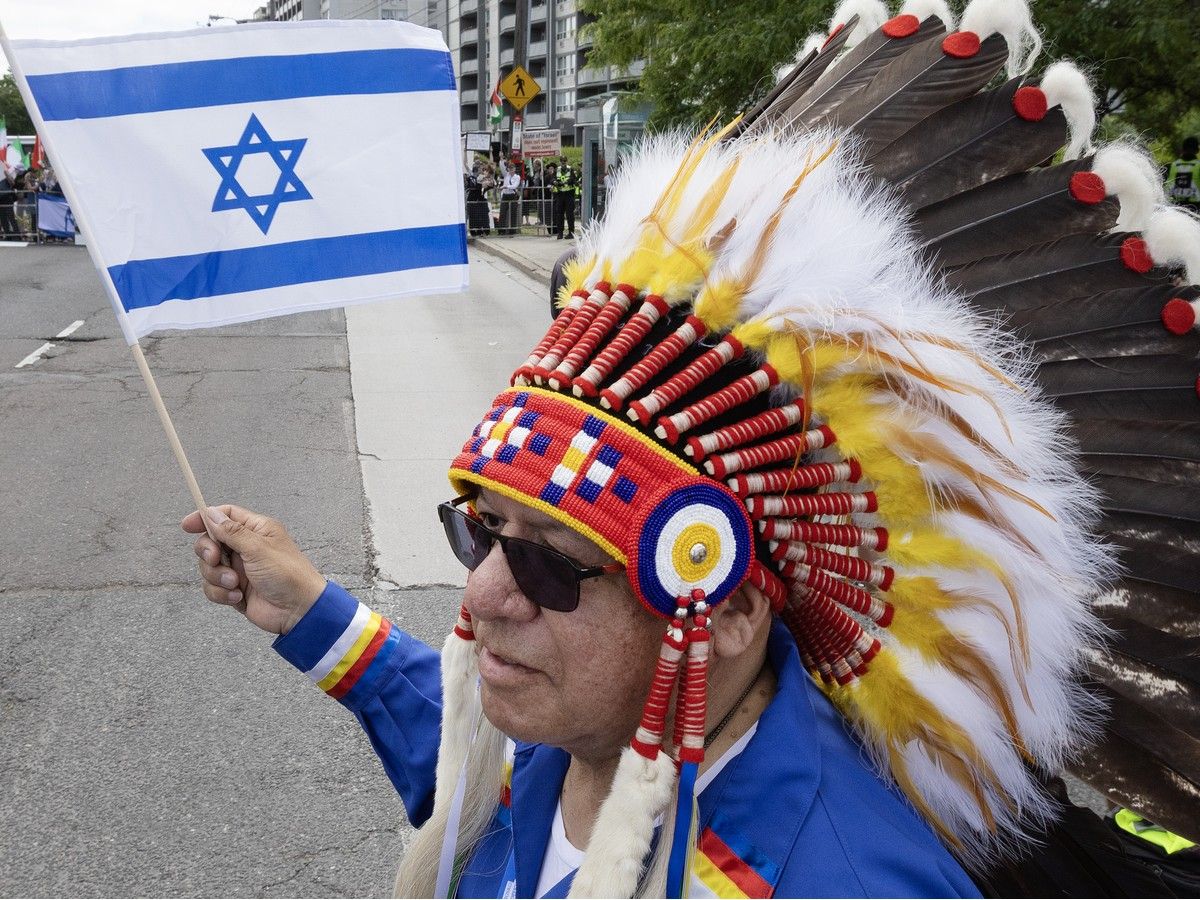
The conference was the culmination of a weekend of local Indigenous-Jewish programming that included nearly 40 Indigenous people marching in the UJA Federation of Greater Toronto’s Walk with Israel, a Sunday dinner-talk with Concordia University professor Csaba Nikolenyi on early 20th-century Zionism, and a Sabbath lecture by Justice Harry S. LaForme at Temple Sinai.
“Indigeneity is demonstrated by historical, collective continuity with a distinct ethnic identity, language, culture, rituals or traditions, economic, social, legal, and religious and spiritual belief systems that predate subsequent invaders or colonizers,” LaForme told Temple Sinai congregants.
“In my view, Israel is the product of the greatest decolonization project in modern history, and this fact does not make it a colonial entity.”
LaForme is Anishibaabe, and a member of the Mississauga of the Credit First Nation. In 1994 he was appointed a judge of the Superior Court of Justice, and in 2004 was appointed to the Ontario Court of Appeal and is the first Indigenous lawyer to be appointed to an appellate court in Canada.
“The Islamist strategists correctly believe that their ideology-driven false narratives appropriating indigenous social justice language would resonate, and given traction with the academically ignorant and the academically sinister in Canada,” he continued in his synagogue speech.
Karen Restoule, an Ojibwe from Dokis First Nation and director of Indigenous affairs at the Macdonald-Laurier Institute, told attendees at Beth Torah that “political movements” have co-opted “Indigenous identity” and the term is “increasingly being treated as a universal political language, borrowed when convenient and deployed in conflicts that arise from very different histories.”
“Increasingly, indigenous identity is being treated as a metaphor, a branding exercise, a political strategy. Indigeneity isn’t any of that; it is a lived reality rooted in specific people and place.”
Trotter said in her talk that “settler colonialism has become a totalizing dogma: it over‑generalizes, homogenizes, and divides the world into saints and sinners, oppressed and oppressor.”
She earned her PhD in history from the University of Auckland, with a thesis on Zionism, and is a Fellow London Centre for the Study of Contemporary Antisemitism.
She added: “Jewish people really need to own their indigeneity for themselves. Even if you don’t live in Israel, your people originate there, and you are part of an indigenous people to that land.”
Ryan Bellerose, a Metis from Alberta, said the conference was “a valuable first step in building bridges between the indigenous Canadian and indigenous Judean people (Jews).”
“As someone who has been trying to build these bridges for years, it is great to see so many people of like mind, people who understand that it’s more than just a shared history of persecution, but also a shared history of love and veneration for our ancestral lands, that really helps bind us. And with Israel being a great example of a successful land back movement, there is much we can learn from our Jewish friends,” he told the Post.
Gilli Zemer and her family hosted two visiting Indigenous leaders, and she told the Post that she “came to learn more about the connections between Indigenous and Jewish communities, and left inspired by how deeply our foundational values align. We have much to learn from one another, and a key message was that Jews need to be more confident in advocating for our own indigenous story.”
Avi Attali, vice-president of Canadian Antisemitism Education Foundation (CAEF), one of the sponsors of the event, told the Post that it “allowed us to exchange views, to learn about each other’s cultures and issues, and tried to seek solutions on how we can help each other in the future.”
The conversation often focused on building a shared framework for allyship — positioning dialogue and relationship-building as tools to counter misinformation about both communities. Sponsors also included the Israel Consulate of Toronto and Western Canada, Kanada House, Indigenous Embassy of Jerusalem, Allied Voices for Israel.
Robert Walker, assistant director of HonestReporting Canada, told the Post that “radical activists have weaponized everything from international law to indigenous lingo in their attempt to rewrite reality. That only works in a vacuum.
“The time has passed to permit this shameless inversion of reality to continue unchallenged. First Nations and Jews are both indigenous peoples who have a right to reclaim the truth from those who try to twist it.”
Upvote
2